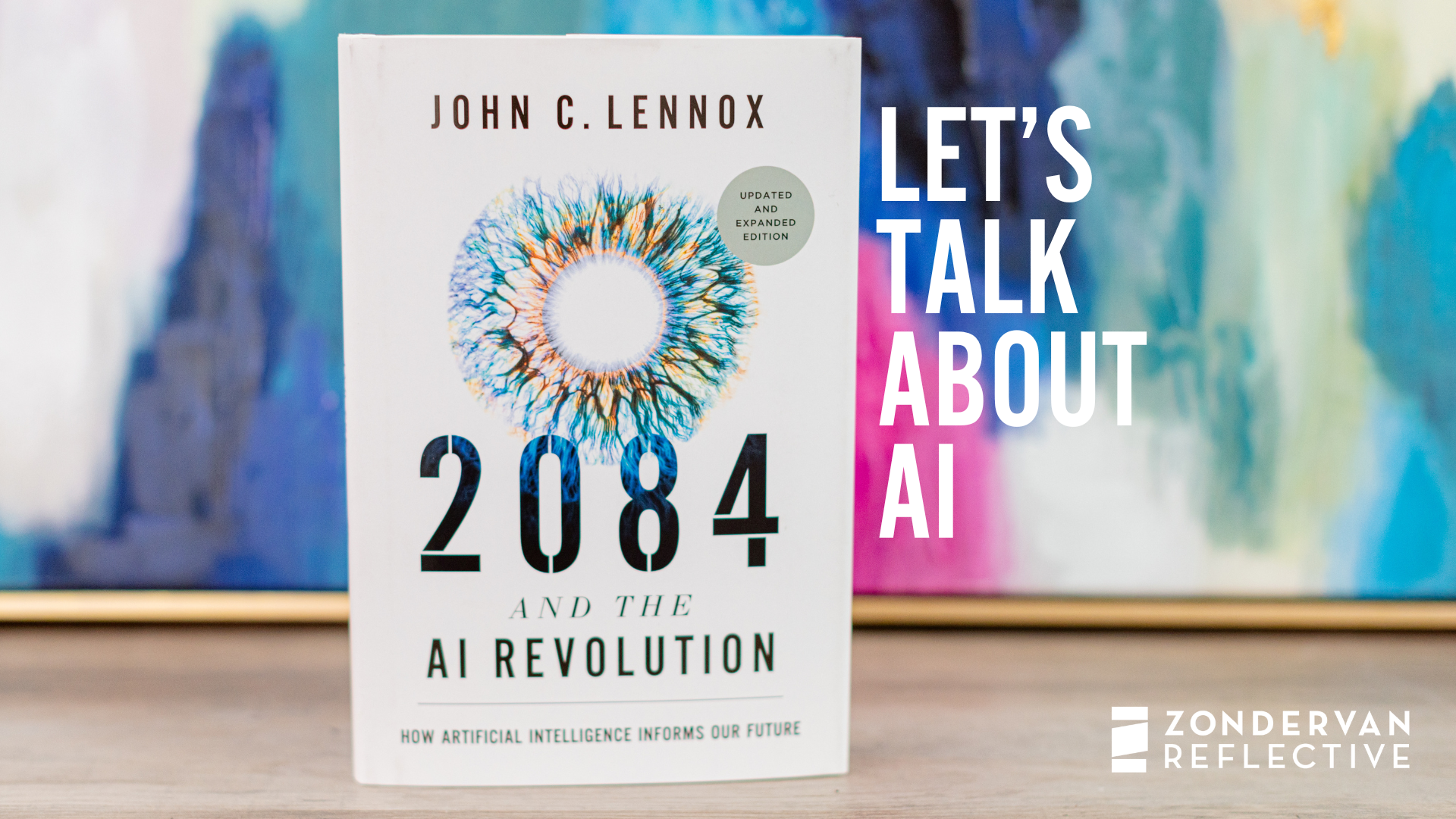
This week the blog is sponsored by Zondervan Reflective. Join the discussion about AI with the newly updated and expanded edition of 2084 and the AI Revolution by John C. Lennox–now available for purchase. Get your copy today!
We humans are insatiably curious. We have been asking big questions since the dawn of history – about knowledge, origin, and destiny. Their importance is obvious. Our answer to the first shapes our concepts of who we are, and our answer to the second gives us goals to live for. Taken together, our responses to these questions frame our world view, the (meta) narrative or ideology that directs our lives and shapes their meaning, the framework of which we are often barely aware. These are not easy questions, as we see from the many and contradictory answers on offer. Yet, by and large, we humans have not let that hinder us. Over the centuries, some answers have been proposed by science, some by philosophy, some based on religion, others on politics, and many on a mixture of all of these and more.
Many current developments were foreshadowed in famous dystopian novels such as the 1931 novel Brave New World by Aldous Huxley and George Orwell’s novel 1984, published in 1949. Of course, neither Huxley nor Orwell knew anything about AI, but nevertheless they imagined a future shaped by the technology around them and by their ability to imagine future developments in that area, many of which imaginings turned out to be prescient.
Philosophers, ethicists, theologians, cultural commentators, novelists, and artists must necessarily get involved in this wider debate.
John C. Lennox
AI has been defined as the theory and development of computer systems that can perform tasks normally requiring human intelligence. The term “AI” is often applied to the machines themselves. Just as the industrial revolution was brought about by the invention of machines designed to help with or replace human physical work, the AI revolution involves the invention of systems that facilitate or replace various forms of both human physical and mental activity. There is now a vast array of AI systems spawned by an information-technology revolution of unprecedented proportions: AI is not one, but many.
Driven by global commercial interests, billions of dollars are now being invested in the development of AI systems. Not surprisingly, there is a great deal of interest in where this is all going: Will it bring about better quality of life through digital assistants, medical innovation, and human enhancement on the one hand, or will it lead to massive job losses, loss of freedom, Orwellian totalitarianism, and possibly the end of humanity altogether on the other?
This topic is not going away anytime soon. Indeed, it is likely to become more of a pressing question as technology advances further. It is of interest not only to people who are directly involved in AI research but also to mathematicians and scientists in other disciplines whose work and outlook are increasingly influenced by it. Indeed, since the outcomes and ideas surrounding work on AI will inevitably affect us all, many people are thinking and writing about it who are not scientists at all. Philosophers, ethicists, theologians, cultural commentators, novelists, and artists must necessarily get involved in this wider debate. After all, you do not need to be a nuclear physicist or climatologist to discuss the impact of nuclear energy or climate change on your life.