

This sponsored post was prepared by Christopher Ash.
 “I would rather wear out than rust out,” George Whitefield once said.
Many pastors today are doing exactly that: Almost half of US pastors and their wives say they have experienced depression or burnout to the extent that they needed to take a leave of absence from ministry (Today’s Pastors (2014), George Barna).
Yet many others in pastoral ministry remain quietly skeptical about the phenomenon of “pastor burnout.” Why not burn out for Jesus? After all, did not the Lord Jesus say something to that effect?
“If anyone would come after me, let him deny himself and take up his cross daily and follow me. For whoever would save his life will lose it, but whoever loses his life for my sake will save it.”
(Luke 9 v 23-24, ESV)
Surely the right response to this challenge from the Lord is to throw ourselves wholeheartedly into his service and the service of his gospel, and not to set limits to our self-giving.
I might have been tempted to think that too—that is, until I came close to the brink of burnout myself.
I had been working for eight busy years leading a Bible training course in central London. In September 2012 I returned from an intense ministry visit to Australia and Singapore to begin an eagerly anticipated sabbatical term. My wife, Carolyn, was looking forward to sharing those weeks with me. Instead, I hit the wall. My energy plummeted; my mood dipped sharply; my morale went through the floor. And I felt empty, used up, expended.
My colleagues at work rallied around generously to help me; but it cost them in time and energy—resources they could otherwise have poured into gospel work elsewhere. That’s the problem: we do not sacrifice alone. It may sound heroic, even romantic, to burn out for Jesus. The reality is that others are implicated in our crashes—a spouse, children, ministry colleagues, prayer partners and faithful friends.
There is a difference between godly sacrifice and needless burnout. After I first gave my first seminar on burnout at the Basics pastors’ conference, a fellow pastor wrote to me:
I put it into terms of fighting fire, as I’m a volunteer firefighter as well as being a pastor. Obviously you have to push yourself physically when fighting a fire. It’s a stretching experience that is uncomfortable and physically difficult. You have to know your limitations while making the sacrifices needed to get the tasks done that must be done.
It’s foolishness to ignore your limitations, try to be the hero, and cramp up, pass out, or have a heart attack while in a burning structure because you’re beyond the limits of what God has supplied you with the capability of doing. It’s a form of heroic suicide that is counterproductive because you’re now no longer effective in fighting fire and the resources that were dedicated to fighting the fire are now dedicated to saving you.
In a similar way, the aim of gospel work is not to be a lone hero, but to work with other gospel workers to spread the gospel of Jesus.
Living Sacrifices
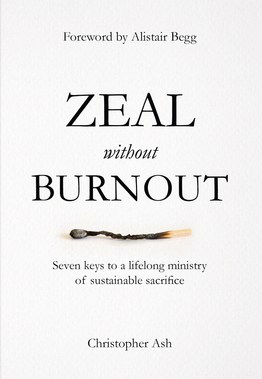
My reason for writing Zeal without Burnout was to help us discern the difference between sacrifice and foolish heroism, and so to guard against needless burnout. Until God takes us home to be with Jesus, we are to offer ourselves as those who have a life to offer, rather than a burned-out wreck:
Therefore, I urge you, brothers and sisters, in view of God’s mercy, to offer your bodies as a living sacrifice, holy and pleasing to God—this is your true and proper worship. (Romans 12 v 1)
A “living sacrifice” is a strange expression. It means a sacrifice that goes on and on being offered, so long as life lasts. When I am off work because of exhaustion, my body has little to offer; I may feel in pain but the sacrifice is barely alive. How much better to keep plodding on in Christian service if we can! Perhaps the expression “sustainable sacrifice” gets to the heart of the idea—the sort of self-giving living that God enables us to go on giving day after day.
We are called to sacrifice, and sometimes that sacrifice will damage or even destroy us in this life. However, the best kinds of ministry—whether in a paid or voluntary role—are, more often than not, long term and low key—a marathon, not a short, energetic sprint. So it is my prayer that Zeal without Burnout will help many of my brothers and sisters to maintain their zeal without knowing the bitterness of burnout.
Pre-order Zeal without Burnout: Seven Keys to Lifelong Ministry of Sustainable Sacrifice by Christopher Ash, with a foreword by Alistair Begg, from The Good Book Company or through Amazon.





