I have written previously about Charles Wesley and his talented and prolific hymn writing. I also mentioned earlier in this series his involvement in bringing us “Christ the Lord Is Risen Today.” But I haven’t yet said anything about how he got into hymn writing.
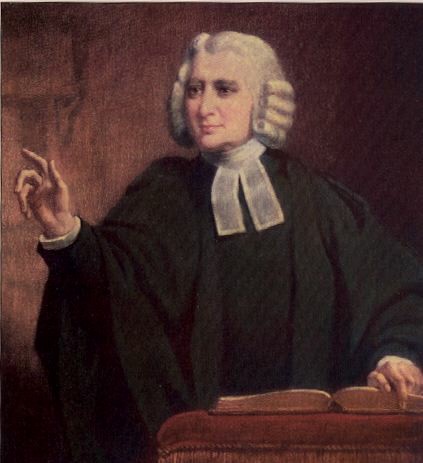 Both Charles and his brother John–two of Susanna Wesley’s 19 children–were zealous for ministry when they finished their studies at Oxford University. Both were soon ordained as clergymen in the Church of England; and in 1735, both sailed to the new colony of Georgia, John as a missionary and Charles as a secretary to General Oglethorpe, who was then governor of the colony.
On that trip they encountered a group of Christians from Germany called Moravians, whose constant singing awakened in John an appreciation for what spiritual songs can do for the Christian life. It wasn’t until 1738, however, after returning to England, that both brothers were truly born again, at which point their ministry took on a whole new character and energy.
John and Charles became itinerant preachers and began organizing meetings that would be called “Methodist societies” (and which would eventually become the Methodist Church). At the start, John would occasionally write hymns, but preaching and leading the new movement eventually took all of his time. Charles, on the other hand, almost immediately discovered a love and ability for writing verse which he would continue for the rest of his life.
He was naturally a poet, and now the writing of religious verse became to him nothing less than a passion. … Every experience of his own, every scene and occasion of the Methodist revival, became the inspiration of a new hymn. He wrote his first within a day or two of his conversion. He dictated his last to his wife from his deathbed, “in age and feebleness extreme.” (Benson)
There is no particular occasion linked to the writing of the hymn “Jesus, Lover of My Soul.” We know from the heading in its original publication (“In Temptation”) that it was apparently meant to be a help in fighting sin. Whether it was written during a time of temptation in Charles’ own life, though, we cannot say.
Throughout its history the hymn has received occasional resistance from those who consider the language to be too intimate for addressing a holy God. Others have defended the vocabulary, however, citing the intimate words God often uses himself in Scripture to refer to his people.
Regardless, after more than 250 years, the hymn remains deeply loved and widely sung. This is a testimony to Charles Wesley’s ability to use biblical language and metaphor to touch a person’s hearts with truth and also express their desires to God.
The hymn has been put to a number of different tunes over the years. Indelible Grace released a recording featuring Matthew Perryman Jones a few years ago that is particularly good and that we sing often at Grace Fellowship Church.
Jesus, lover of my soul,
let me to thy bosom fly,
while the nearer waters roll,
while the tempest still is high.
Hide me, O my Savior, hide,
till the storm of life is past;
safe into the haven guide;
O receive my soul at last.Other refuge have I none,
hangs my helpless soul on thee;
leave, ah! leave me not alone,
still support and comfort me.
All my trust on thee is stayed,
all my help from thee I bring;
cover my defenseless head
with the shadow of thy wing.Wilt Thou not regard my call?
Wilt Thou not accept my prayer?
Lo! I sink, I faint, I fall-
Lo! on Thee I cast my care;
Reach me out Thy gracious hand!
While I of Thy strength receive,
Hoping against hope I stand,
dying, and behold, I live.Thou, O Christ, art all I want,
more than all in thee I find;
raise the fallen, cheer the faint,
heal the sick, and lead the blind.
Just and holy is thy name,
I am all unrighteousness;
false and full of sin I am;
thou art full of truth and grace.Plenteous grace with thee is found,
grace to cover all my sin;
let the healing streams abound,
make and keep me pure within.
Thou of life the fountain art,
freely let me take of thee;
spring thou up within my heart;
rise to all eternity.